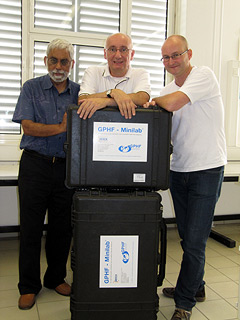
On September 14, the 333rd GPHF-Minilab® arrived in Bischkek, the capital of Kyrgyzstan. The Medicines Transparency Alliance (MeTA), a British initiative, is now training government health care workers to detect counterfeit medicines using this mini-laboratory developed by the Global Pharma Health Fund (GPHF).
Frank Gotthardt, Chairman of the GPHF, said: “We are pleased to see that again another partner organisation provides development assistance by using our Minilabs. Actually, this is the 333rd mobile laboratory and another special milestone. We are continuously working to get more partners on board."
According to information from MeTA, numerous counterfeit medicines are smuggled into the country, which has a population of slightly more than 5 million. The government has hardly been able to stop the influx - partly because of the mountainous terrain, which makes controls difficult. Another reason is the sheer lack of facilities to help distinguish counterfeit from original medicines.
Bringing light into the darkness: 333rd Minilab exposes counterfeit medicines in KyrgyzstanOn target: GPHF-Minilab® capable of testing more than 50 drugs as of 2010As of January 2010, additional thin layer chromatographic tests will be added to the 41 existing test protocols. This means that more than 50 drug compounds can then be tested using the GPHF-Minilab®. The development work was co-financed by the U.S. partner organisations USAID and USP and includes active ingredients for the treatment of tuberculosis and malaria, among others. The new supplementary manual will be published in English, French and Spanish. GPHF-Minilab Summer School 2009
Pharmacists from East Timor, Norway, France and the United Kingdom attended the GPHF-Minilab® training courses that took place in July and September. As in the previous year, Dr. Richard Jähnke, GPHF project manager, held the three to five-day courses at the Pharmaceutical Institute of the University of Frankfurt.
GPHF donates Minilabs to Ministry of Health in Gambia
To provide better protection against counterfeit medicines, the Global Pharma Health Fund donated two mini-laboratories to the Gambia Health Alliance for drug quality monitoring in Gambia. To ensure optimum use of the Minilab, pharmacists and technicians from the National Pharmaceutical Services will be trained by GPHF project manager Dr. Richard Jähnke in October, who will also support them in performing initial tests.
Minilab manuals as teaching material in chemistry classesAn article in a science journal for German school teachers is scheduled for publication next month. By presenting the topic of counterfeit medicines and ways to detect them, the GPHF wants to offer some ideas to make classroom instruction more practice-relevant. Short test demonstrations will proof the potential benefits when using GPHF-Minilab manuals on colour reactions and thin layer chromatography in chemistry classes. Antimalarial Medicines in Papua New GuineaTogether with the University of Frankfurt and the malaria project of Oil Search (PNG) Ltd., the Global Pharma Health Fund is supporting a study assessing the situation on counterfeit antimalarial medicines proliferation in Papua New Guinea. The national medical stores and the school of medicine of PNG University are conducting the study. A pharmacist from PNG University will also come to Frankfurt and subject medicines of borderline quality to more sophisticated pharmacopoeial quality tests. The results of the study are expected by mid-2010. International News
July: Counterfeit malaria drug Coartem® detected in Ghana contained absolutely no medicinal substances
Organisational issues
On July 6, 2009. Dr. Jürgen Knackmuss stepped down as Chairman of the GPHF. The new Chairman is Frank Gotthardt.
Published by: The Global Pharma Health Fund e.V. (GPHF) is a charitable organisation initiated and maintained by Merck, Darmstadt • Germany If you no longer want to receive GPHF News, please click here. |